
How to Choose Paper Machine Nozzles: Wet End vs. Dry End Engineering Guide
A single rogue water drop on the dry end can ruin an entire roll of coated paper, while a clogged nozzle on the wet end guarantees one thing: costly machine downtime. For maintenance engineers and production managers in the pulp and paper industry, selecting the right paper machine nozzles is not just a purchasing decision—it is a critical operational strategy. The requirements for the wet end (forming and pressing) and the dry end (drying and coating) are fundamentally different. This comprehensive engineering guide will break down exactly how to evaluate, compare, and select the right nozzle technologies for each section. By the end of this article, you will know exactly how to optimize your spray systems to eliminate paper defects, reduce freshwater consumption, and maximize your machine's uptime.

Table of Contents
1. Understanding Paper Machine Nozzles: The Basics
In modern paper manufacturing, spray nozzles are the unsung heroes of quality control and equipment maintenance. However, applying a "one-size-fits-all" approach to your spray headers is a guaranteed recipe for production failures.
Overseas engineers often face immense pressure to maintain high Overall Equipment Effectiveness (OEE). When a paper web breaks or coating spots appear, the root cause frequently traces back to improper nozzle selection or maintenance.
Here is why getting your nozzle selection right is critical for your bottom line:
- Downtime Reduction: Every minute spent manually cleaning a clogged shower pipe on the forming fabric costs thousands of dollars in lost production.
- Quality Assurance: Uneven spray distribution directly causes moisture profile variations, leading to edge curling, blistering, or uneven coating thickness.
- Sustainability & ROI: Paper mills consume massive amounts of water. Upgrading to precision-engineered nozzles can save hundreds of thousands of gallons of freshwater per shift, drastically reducing wastewater treatment costs and ensuring compliance with strict environmental regulations.
To make an informed decision, you must first understand the drastically different environments these nozzles operate in.
2. Core Concepts Simplified: Wet End vs. Dry End
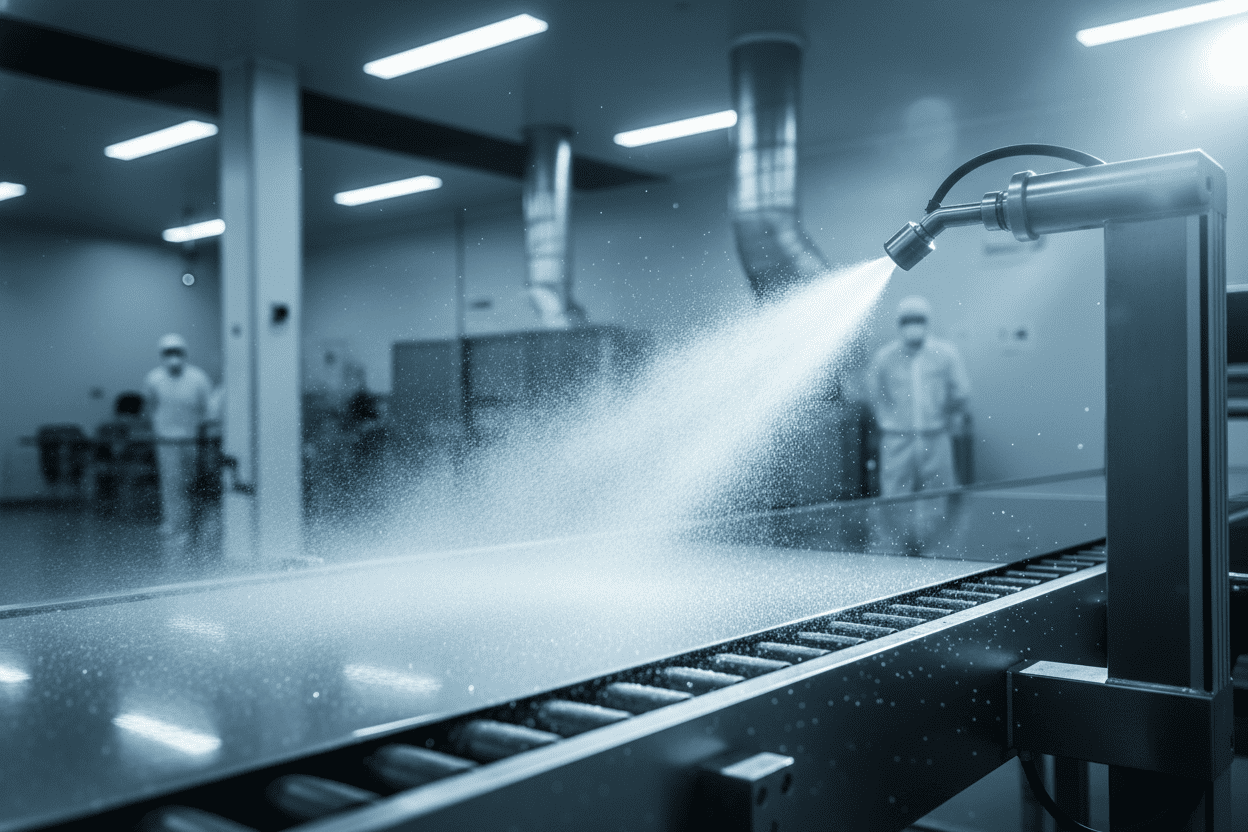
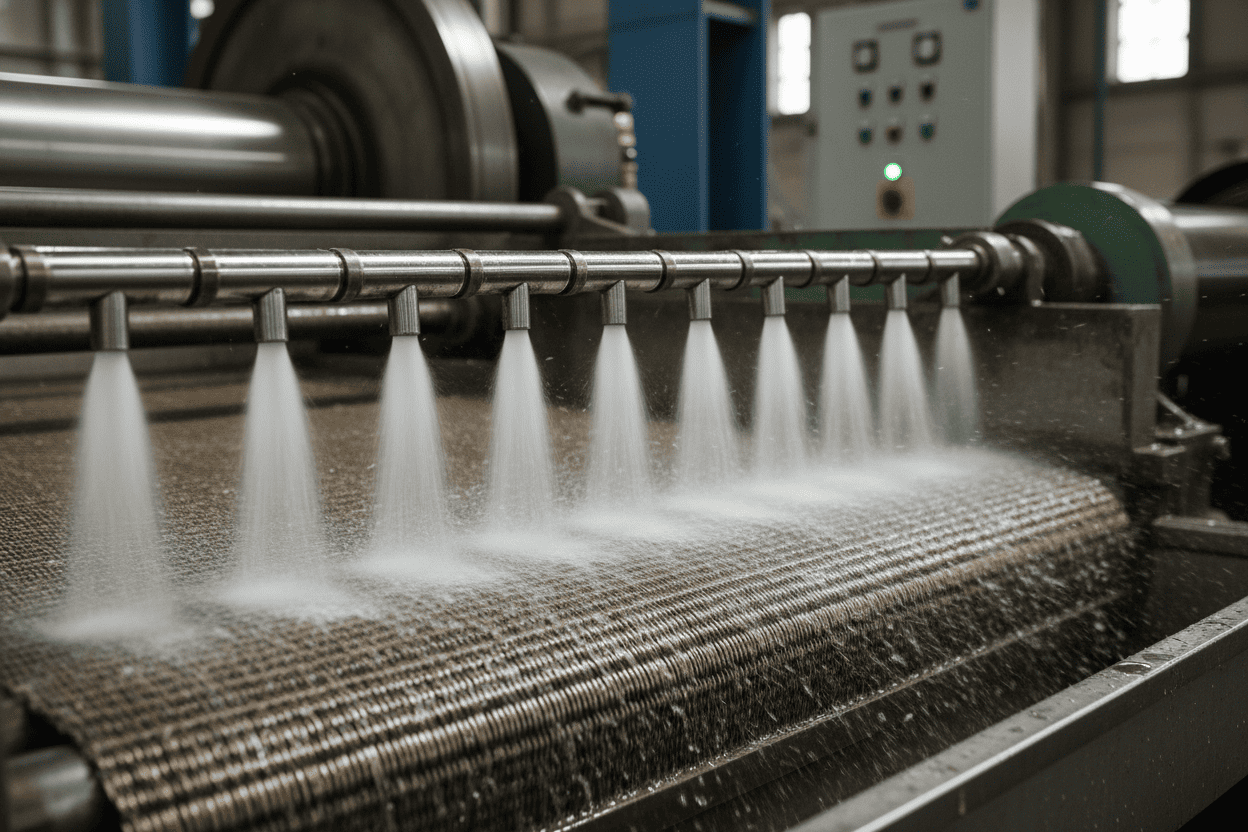
To simplify the engineering jargon, let's use a practical analogy: Think of the Wet End as a heavy-duty Power Washer. Its primary job is brute force and high-impact cleaning to blast away sticky pulp fibers and keep the forming fabrics (wires) and felts completely clean. It operates in a harsh, debris-filled environment where clogging is the enemy. Think of the Dry End as a Precision Airbrush. Its job is delicate and exact. It must apply moisture or chemical coatings in a microscopic, uniform mist without ever dripping a single drop onto the fast-moving, dry paper web.
Below is a detailed comparison to help you conceptualize the differing engineering requirements:
Wet End vs. Dry End Nozzle Comparison Table
| Feature / Requirement | Wet End (Forming & Pressing Sections) | Dry End (Drying & Coating Sections) |
|---|---|---|
| Primary Objective | High-impact cleaning, fabric conditioning, knock-off. | Precision coating, edge trimming, moisture profiling. |
| Crucial Nozzle Tech | Flat fan angles, large free-passage (anti-clogging). | Fine atomization precision, anti-drip check valves. |
| Fluid Handled | White water, clarified water, high-pressure fresh water. | Chemical coatings, starches, clean misting water. |
| Biggest Production Risk | Nozzle clogging leading to dirty wires and web breaks. | Unwanted water drips causing coating spots or sheet breaks. |
| Flow Rate & Pressure | High flow, High pressure (up to 1000+ PSI for cleaning). | Low flow, precise low-pressure control. |

3. Step-by-Step Guide: Making the Right Engineering Choice
When you are comparing options from different manufacturers, you need to look at specific technical specifications based on where the nozzle will be installed.
3.1 Scenario A: Wet End Selection (High-Impact & Anti-Clogging)
In the wet end, your primary battle is against pulp buildup. If your forming wire is not completely clean, the paper formation will be poor, and the web will eventually break.
Key Selection Criteria for the Wet End:
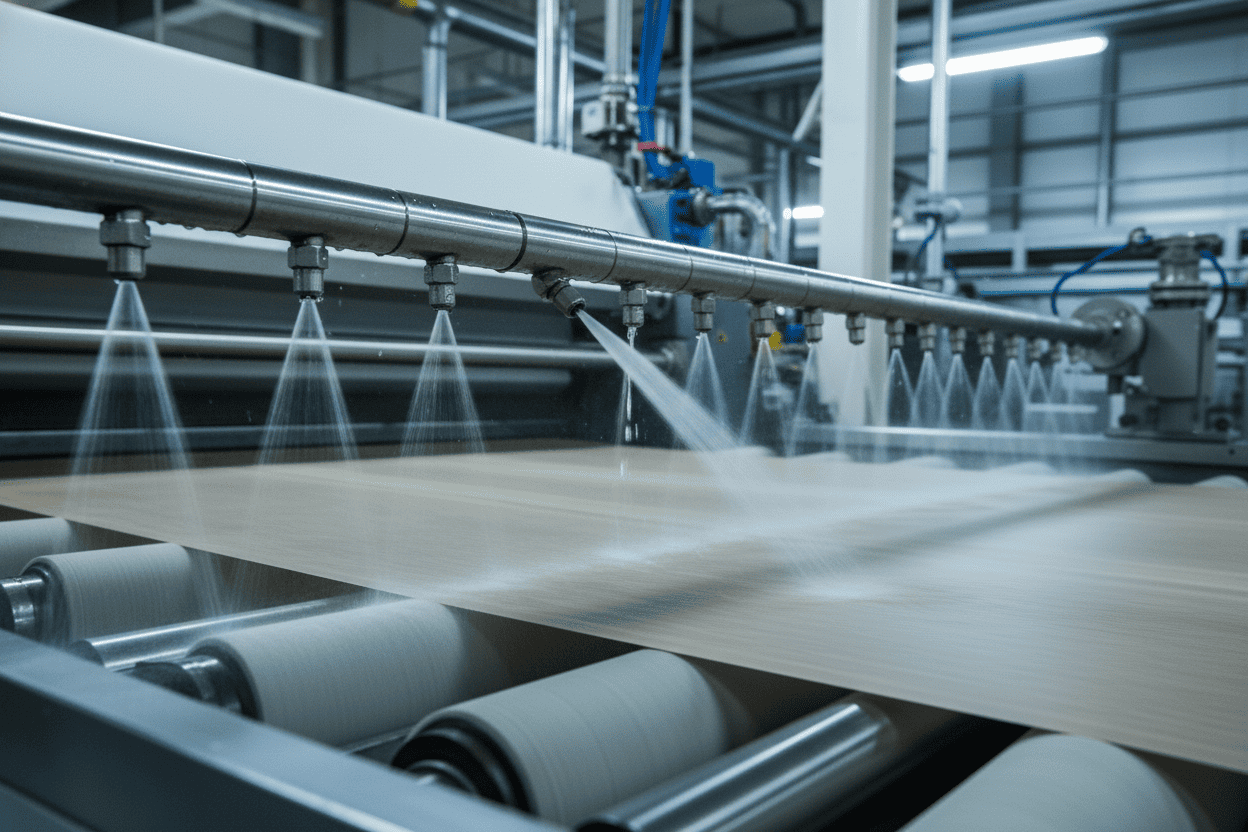
- Flat Fan Nozzle Angle: The V-shaped angle of the spray dictates the impact force and the coverage area. A narrower angle (e.g., 15° to 30°) provides a higher impact force for aggressive cleaning, while a wider angle (e.g., 60°) covers more area but with less force.
- Overlap Calculation: To prevent "striping" (uncleaned lines on the wire), you must calculate the exact distance between nozzles on the shower header and their distance to the fabric.
- Clog Resistance: Always look for nozzles with a "maximum free passage" design. If you are using recycled white water, an internal strainer or a self-cleaning shower header is mandatory.
If you are struggling with dirty forming fabrics or uneven cleaning, you must dive deeper into optimizing flat fan nozzle angles to ensure perfect wire cleaning coverage without wasting water pressure.
Engineering Specification Table: Recommended Wet End Angles
| Target Application | Recommended Spray Angle | Optimal Header Distance (to target) | Impact Force Level |
|---|---|---|---|
| High-Pressure Knock-off | 15° - 25° | 4 to 6 inches | Extremely High |
| Wire / Fabric Cleaning | 45° - 60° | 6 to 10 inches | High |
| Low-Pressure Flooding | 90° - 120° | 10+ inches | Low (Volume focused) |

3.2 Scenario B: Dry End Selection (Precision & Anti-Drip)
The dry end is unforgiving. By the time the paper reaches the coating or calendering section, immense energy and money have already been invested in it. A single flaw here is catastrophic.
Key Selection Criteria for the Dry End:
- Atomization Precision: The nozzle must break the fluid (water or starch/coating) into uniformly sized micro-droplets. If the droplets are too large, they will soak the paper unevenly. Air-atomizing nozzles are frequently the best choice here.
- Anti-Drip Check Valves: This is non-negotiable. When the spray header shuts off, residual fluid in the pipe will naturally want to drip out of the nozzle due to gravity. An anti-drip check valve is a micro-spring mechanism inside the nozzle that instantly snaps shut when the fluid pressure drops below a certain threshold (e.g., 10 PSI).
If your mill is plagued by ruined paper rolls due to mysterious water spots, you need to implement solutions to stop nozzle dripping in paper coating immediately.
4. Expert Tips & Common Pitfalls to Avoid
Drawing from extensive discussions on TAPPI (Technical Association of the Pulp and Paper Industry) forums and real-world mill audits, here are the most common mistakes maintenance teams make—and how to avoid them.
Pitfall 1: Ignoring Pressure Drops Across the Header Many engineers assume that if the pump outputs 100 PSI, all 40 nozzles on the shower pipe are receiving 100 PSI. This is false. Due to friction and fluid dynamics, the nozzles at the far end of the pipe may only see 80 PSI.
- The Fix: Use center-fed header pipes instead of end-fed pipes for critical coating applications to ensure uniform pressure and droplet size across the entire paper web.
Pitfall 2: Using Wire Brushes for Cleaning When a nozzle clogs, the instinct is to grab a wire brush or a needle to clear the orifice. For precision dry end nozzles, this microscopic scratching alters the spray pattern and ruins the atomization quality.
- The Fix: Use ultrasonic cleaning baths or chemical soaking for precision nozzles.
Pitfall 3: Overlooking the Water Sustainability ROI Replacing worn nozzles is often seen as a nuisance cost. However, a nozzle orifice that has worn just 10% larger can waste millions of gallons of water annually.
- The Fix: Implement a proactive replacement schedule. Upgrading to wear-resistant materials (like Ruby or Silicon Carbide inserts for high-pressure wet end applications) will drastically extend lifespan and save thousands of dollars in water treatment costs per shift.

5. Conclusion & Final Thoughts
Selecting the right nozzles for your paper machine is a balancing act between aggressive cleaning power and delicate precision. The wet end demands rugged, anti-clogging designs with precise flat fan angles to keep your fabrics clean and your machine running. Conversely, the dry end requires absolute finesse, relying on superior atomization and foolproof anti-drip valves to protect the final product's quality.
By moving away from a generic purchasing mindset and adopting a highly specific, application-based selection process, you will immediately see a reduction in web breaks, a drop in freshwater consumption, and a significant improvement in paper quality.
6. Quick Summary: Nozzle Selection Checklist
| Section | Primary Focus | Must-Have Feature | Avoid At All Costs |
|---|---|---|---|
| Wet End | Continuous uptime, clean wires. | Large free-passage, correct fan angle. | Using clean-water nozzles for recycled white water. |
| Dry End | Defect-free paper, uniform coating. | Anti-drip check valves, fine atomization. | Ignoring pressure drops, manual wire brush cleaning. |
If you are ready to upgrade your mill's efficiency, explore a full range of high-performance spray nozzles for paper industry designed specifically to tackle these distinct engineering challenges.
7. Frequently Asked Questions
Q1: What is the difference between wet end and dry end paper machine nozzles? A: Wet end nozzles deliver high-impact flat fan sprays for cleaning forming fabrics. Dry end nozzles provide precision atomization for coating and moisture profiling.
Q2: How do I prevent nozzle clogging on the wet end? A: Specify large free-passage nozzles with internal strainers or self-cleaning shower headers designed for recycled white water.
Q3: Why are anti-drip check valves critical on the dry end? A: They seal the orifice instantly when pressure drops, preventing residual fluid from dripping onto the paper web and causing coating spots.
Q4: How often should I replace paper machine nozzles? A: Follow a proactive schedule based on flow-rate audits. A 10% worn orifice wastes massive amounts of water and degrades spray quality.
Q5: What is the correct way to clean precision dry end nozzles? A: Use ultrasonic cleaning baths or chemical solvents. Never use wire brushes or metal tools that damage internal geometries.