
Full Cone Nozzles vs Hollow Cone Nozzles: Which to Choose?
Industrial facilities invest heavily in spray systems for cooling, cleaning, coating, and process control applications. Choosing between full cone and hollow cone nozzles directly impacts spray efficiency, coverage quality, and operational costs. If you want to select the right nozzle type for your manufacturing application, then you will need to understand spray pattern characteristics, droplet formation, pressure requirements, and industry-specific performance demands.
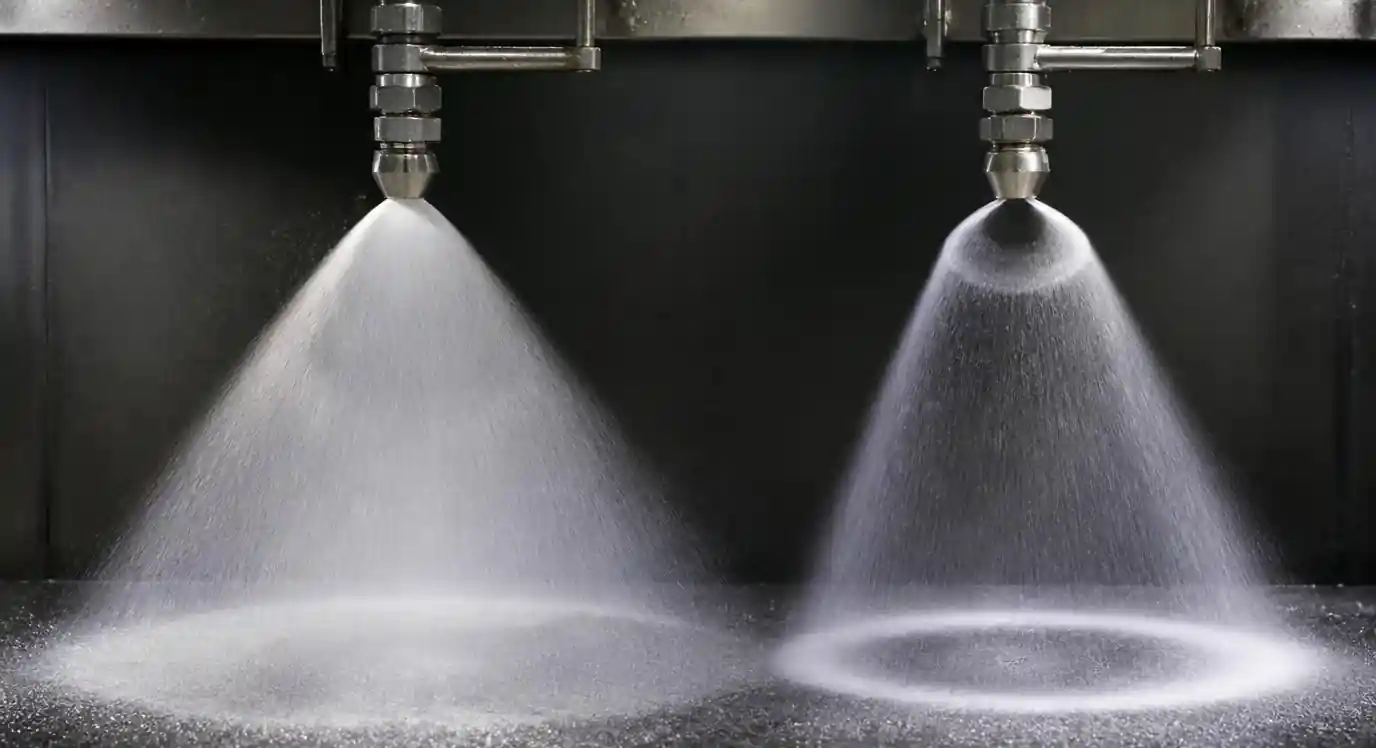
Full cone nozzles deliver uniform circular coverage with droplets distributed throughout the entire spray cone, making them suitable for applications requiring consistent impact across the spray area. Hollow cone nozzles produce a ring-shaped spray pattern with concentrated droplets at the outer edge, creating superior atomization for gas scrubbing and chemical processing applications. Understanding these fundamental differences helps engineers and facility managers specify nozzles that optimize performance while reducing water consumption and energy costs.
Full cone and hollow cone spray pattern comparison showing distribution differences
- 1. What Are Full Cone Nozzles?
- 2. What Are Hollow Cone Nozzles?
- 3. Key Differences Between Full Cone and Hollow Cone Nozzles
- 3.1. Spray Pattern Characteristics
- 3.2. Atomization Performance
- 3.3. Pressure Requirements and Flow Characteristics
- 4. Primary Applications for Full Cone Nozzles
- 4.1. Tank Cleaning and Washing Systems
- 4.2. Fire Suppression and Cooling Systems
- 4.3. Dust Suppression and Humidification
- 5. Primary Applications for Hollow Cone Nozzles
- 5.1. Gas Scrubbing and Chemical Processing
- 5.2. Agricultural Spraying and Crop Protection
- 5.3. Coating and Spray Drying Applications
- 5.4. Evaporative Cooling and Gas Conditioning
- 6. Material Selection and Durability Considerations
- 6.1. Stainless Steel Construction
- 6.2. Brass and Plastic Options
- 6.3. Ceramic and Hardened Materials
- 7. Selection Criteria: Choosing the Right Nozzle Type
- 7.1. Coverage Requirements
- 7.2. Droplet Size and Atomization Quality
- 7.3. System Pressure Availability
- 7.4. Flow Rate and Coverage Area
- 8. Maintenance and Performance Optimization
- 8.1. Filtration Requirements
- 8.2. Inspection and Replacement Schedules
- 8.3. Performance Verification
- 9. Frequently Asked Questions
- 9.1. What is the main difference between full cone and hollow cone spray patterns?
- 9.2. Which nozzle type produces smaller droplets?
- 9.3. Can I use full cone nozzles for chemical scrubbing applications?
- 9.4. What pressure do I need for optimal full cone nozzle performance?
- 9.5. Are hollow cone nozzles suitable for tank cleaning?
- 9.6. How do I calculate the number of nozzles needed for my application?
- 9.7. What materials are best for corrosive chemical applications?
- 9.8. How often should I replace spray nozzles?
- 10. Conclusion
What Are Full Cone Nozzles?
Full cone nozzles are precision spray devices that produce a solid circular spray pattern with droplets distributed uniformly throughout the entire cone area. The nozzle uses internal vanes or swirl chambers to impart rotational motion to the liquid, creating a complete cone filled with evenly sized droplets from center to edge.
This spray configuration delivers consistent coverage over circular areas, with flow rates typically ranging from 0.5 to 50 GPM (2 to 190 LPM) at pressures between 40-100 psi (3-7 bar). The uniform droplet distribution makes full cone nozzles highly effective for applications requiring even wetting, consistent impact force, and predictable spray coverage.
You can specify full cone nozzles for tank washing, cooling towers, fire suppression systems, dust control, and general washing applications where complete area coverage is critical. The nozzles are available in spray angles from 15° to 120°, with orifice sizes ranging from 0.5mm to 25mm depending on flow requirements.
Full cone nozzle cutaway showing internal vanes and swirl chamber design
What Are Hollow Cone Nozzles?
Hollow cone nozzles are engineered spray devices that produce a ring-shaped spray pattern with droplets concentrated at the outer periphery of the cone. The nozzle design uses tangential inlets or swirl chambers to create rotational liquid flow, generating a hollow center with fine droplets forming the cone's outer surface.
This spray pattern creates smaller droplet sizes compared to full cone nozzles, typically producing droplets between 50-200 microns at standard operating pressures of 60-150 psi (4-10 bar). The fine atomization and large liquid surface area provide excellent gas-liquid contact, making hollow cone nozzles ideal for chemical reactions, gas scrubbing, and coating applications.
You can use hollow cone nozzles for spray drying, gas cooling, evaporative cooling, chemical processing, agricultural spraying, and any application where fine droplet size and maximum surface area are required. The nozzles deliver flow rates from 0.3 to 40 GPM (1 to 150 LPM) with spray angles ranging from 30° to 120°.
Hollow cone nozzle in operation showing fine atomization and ring-shaped pattern
Key Differences Between Full Cone and Hollow Cone Nozzles
Spray Pattern Characteristics
Full cone nozzles produce a solid circular pattern with droplets distributed throughout the entire spray area, creating uniform coverage from the cone center to its outer edge. The spray density remains relatively consistent across the pattern, delivering predictable wetting and impact across circular target areas.
Hollow cone nozzles generate a ring-shaped pattern with droplets concentrated at the cone periphery and minimal spray in the center. This configuration creates a toroidal (donut-shaped) liquid distribution, with peak flow density occurring at the outer edge of the spray cone.
| Characteristic | Full Cone Nozzles | Hollow Cone Nozzles |
|---|---|---|
| Spray Pattern | Solid circular with uniform distribution | Ring-shaped with hollow center |
| Droplet Distribution | Throughout entire cone area | Concentrated at outer edge |
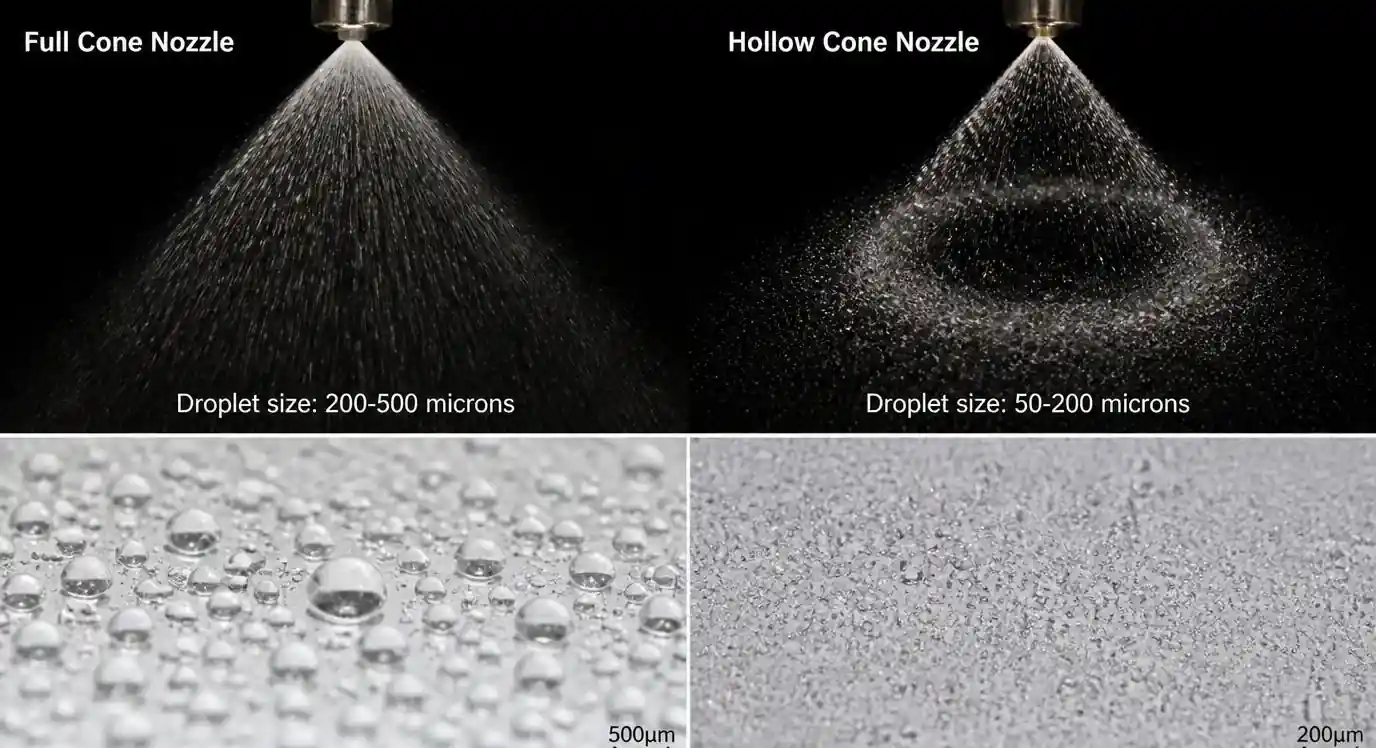
| Droplet Size | Medium (200-500 microns) | Fine to medium (50-200 microns) |
| Spray Angle Range | 15° to 120° | 30° to 120° |
| Impact Force | Medium to high | High at periphery, low at center |
| Flow Rate Range | 0.5 to 50 GPM | 0.3 to 40 GPM |
Atomization Performance
Full cone nozzles produce medium-sized droplets with moderate atomization quality, suitable for applications requiring solid coverage and moderate surface wetting. The droplet size spectrum is broader compared to hollow cone designs, ranging from 200 to 500 microns depending on pressure and orifice configuration.
Hollow cone nozzles deliver superior atomization with significantly smaller droplets, typically 50-200 microns at operating pressures. The centrifugal force generated by the swirl chamber breaks the liquid into finer particles, creating a larger total surface area per unit volume. This enhanced atomization makes hollow cone nozzles highly effective for chemical reactions, cooling, and coating applications where droplet size directly affects performance.
Microscopic comparison of full cone and hollow cone nozzle droplet sizes
Pressure Requirements and Flow Characteristics
Full cone nozzles operate effectively at moderate pressures, typically 40-100 psi (3-7 bar), delivering predictable flow rates across a wide pressure range. The spray pattern remains stable even at lower pressures, making these nozzles suitable for systems with variable pressure conditions.
Hollow cone nozzles require higher operating pressures, generally 60-150 psi (4-10 bar), to achieve optimal atomization and maintain spray pattern quality. The fine droplet formation depends on sufficient centrifugal force, which increases with pressure. Lower pressures result in larger droplets and degraded spray quality.
| Pressure Parameter | Full Cone Nozzles | Hollow Cone Nozzles |
|---|---|---|
| Optimal Pressure Range | 40-100 psi (3-7 bar) | 60-150 psi (4-10 bar) |
| Minimum Operating Pressure | 20 psi (1.4 bar) | 40 psi (2.8 bar) |
| Maximum Operating Pressure | 150 psi (10 bar) | 250 psi (17 bar) |
| Pressure Sensitivity | Low - maintains pattern | High - affects atomization |
| Flow Rate Calculation | Q = k√P (flow proportional to √pressure) | Q = k√P (flow proportional to √pressure) |
Primary Applications for Full Cone Nozzles
Tank Cleaning and Washing Systems
Full cone nozzles provide thorough coverage for cleaning vessel interiors, storage tanks, and process equipment. The uniform spray pattern ensures complete wetting of tank walls and internal surfaces, removing residue, scale, and product buildup. You can install static full cone nozzles for rinsing applications or specify rotary full cone nozzles for high-impact 360° cleaning.
CIP (clean-in-place) systems in food processing, pharmaceutical manufacturing, and beverage production frequently use full cone nozzles to achieve sanitary cleaning standards per FDA and 3-A requirements. Flow rates from 10 to 50 GPM at 60-80 psi deliver the impact force needed to remove stubborn residues while maintaining reasonable water consumption.
Fire Suppression and Cooling Systems
Full cone water mist nozzles are specified for fire suppression systems in industrial facilities, commercial buildings, and marine applications. The uniform droplet distribution provides effective fire suppression while using less water than traditional sprinkler systems, meeting NFPA standards for water mist fire protection.
Cooling tower applications use full cone nozzles to distribute water evenly across fill media, maximizing air-water contact and heat transfer efficiency. The nozzles operate at 20-40 psi, delivering flow rates matched to cooling load requirements while minimizing pressure drop and pump energy consumption.
Full cone nozzles installed in industrial tank cleaning system
Dust Suppression and Humidification
Full cone misting nozzles control airborne dust in mining operations, construction sites, material handling facilities, and warehousing operations. The uniform spray coverage creates a water curtain that captures dust particles and prevents dispersion, improving air quality and worker safety.
Humidification systems in textile mills, printing facilities, and electronics manufacturing use full cone nozzles to maintain precise humidity levels. Operating at 1000-1500 psi (70-100 bar), fine mist full cone nozzles produce droplets small enough to flash evaporate before reaching surfaces, preventing wetting damage to products and equipment.
Primary Applications for Hollow Cone Nozzles
Gas Scrubbing and Chemical Processing
Hollow cone nozzles excel in gas scrubbing applications where maximum liquid surface area is required for chemical absorption and particulate removal. The fine droplet size and large surface-to-volume ratio create superior gas-liquid contact, improving scrubbing efficiency in flue gas desulfurization, acid gas removal, and industrial exhaust treatment systems.
Chemical reactors use hollow cone nozzles for reagent injection, quench cooling, and process control applications. The fine atomization ensures rapid mixing and complete reaction kinetics, critical for controlling exothermic reactions and maintaining product quality in pharmaceutical synthesis and specialty chemical manufacturing.
Agricultural Spraying and Crop Protection
Hollow cone nozzles are the standard for agricultural pesticide and herbicide application in orchards, vineyards, and specialty crop production. The fine droplets provide excellent coverage on plant surfaces, including undersides of leaves, while minimizing chemical waste and environmental impact.
You can specify hollow cone nozzles for airblast sprayers and high-pressure spray systems delivering 100-300 psi (7-20 bar) to achieve droplet sizes between 100-200 microns. This droplet spectrum balances coverage quality with drift control, meeting EPA guidelines for responsible pesticide application.
Hollow cone nozzles in agricultural crop spraying equipment
Coating and Spray Drying Applications
Hollow cone nozzles are widely used in spray coating systems for applying paints, adhesives, release agents, and protective coatings. The uniform droplet size distribution creates consistent film thickness and finish quality in automotive painting, industrial coating, and specialty finishing operations.
Spray drying processes in food, pharmaceutical, and chemical industries rely on hollow cone nozzles to atomize liquid feed into hot gas streams. The fine droplets produced at 150-250 psi (10-17 bar) evaporate rapidly, producing uniform powder particles with controlled size distribution and moisture content.
Evaporative Cooling and Gas Conditioning
Hollow cone nozzles provide highly efficient evaporative cooling in gas turbine inlet cooling, process gas conditioning, and industrial ventilation systems. The fine droplet size maximizes evaporation rate, reducing gas temperature while minimizing water consumption and eliminating surface wetting issues.
Data centers and electronics manufacturing facilities use hollow cone fog nozzles for precision humidity control and adiabatic cooling. Operating at ultra-high pressures (1000-1500 psi / 70-100 bar), these nozzles produce droplets smaller than 10 microns that flash evaporate instantly, providing cooling without moisture deposition on equipment.
Hollow cone fog nozzles in industrial evaporative cooling installation
Material Selection and Durability Considerations
Stainless Steel Construction
Both full cone and hollow cone nozzles are available in 304 and 316 stainless steel grades for corrosion resistance in food processing, pharmaceutical, and chemical applications. Stainless steel nozzles withstand temperatures from -40°F to 400°F (-40°C to 200°C) and resist chemical attack from acids, alkalis, and organic solvents.
You should specify 316 or 316L stainless steel for applications involving chlorides, marine environments, or high-purity processes requiring sanitary design per 3-A standards. The material provides excellent wear resistance and maintains spray pattern consistency over extended service life, typically 5-10 years in properly filtered systems.
Brass and Plastic Options
Brass nozzles offer cost-effective performance for general industrial applications with non-corrosive fluids at temperatures below 250°F (120°C). The material machines precisely for tight tolerances but wears faster than stainless steel when spraying abrasive fluids or operating at high pressures.
Plastic nozzles manufactured from PVDF, PP, or PVC provide chemical resistance for acids and caustics at lower cost than stainless steel. You can use plastic nozzles for chemical scrubbing, wastewater treatment, and agricultural applications where operating temperatures remain below 180°F (80°C). The material resists chemical corrosion but offers lower impact strength and pressure ratings compared to metal construction.
Ceramic and Hardened Materials
Ceramic nozzles deliver exceptional wear resistance for abrasive spray applications involving slurries, suspended solids, or high-velocity operation. Silicon carbide and aluminum oxide ceramics extend service life 10-20 times compared to stainless steel when spraying abrasive fluids, reducing replacement costs and maintenance downtime.
Tungsten carbide and hardened steel inserts provide wear protection for high-pressure nozzles operating above 1000 psi (70 bar). You should specify hardened materials for fog nozzles, atomizing nozzles, and any application where orifice wear affects spray quality and system performance.
Selection Criteria: Choosing the Right Nozzle Type
Coverage Requirements
Choose full cone nozzles when you need uniform coverage over circular areas with consistent wetting and impact force distribution. Applications requiring complete area coverage, such as tank cleaning, dust suppression, and cooling, benefit from the solid spray pattern and predictable droplet distribution.
Specify hollow cone nozzles when fine droplet size and maximum liquid surface area are more important than uniform area coverage. Chemical processing, gas scrubbing, and coating applications where atomization quality affects reaction efficiency or product quality require the superior droplet formation that hollow cone nozzles provide.
Droplet Size and Atomization Quality
Select full cone nozzles for applications accepting medium droplet sizes (200-500 microns) where spray impact and coverage area are primary concerns. The moderate atomization is sufficient for washing, rinsing, cooling, and fire suppression applications.
Choose hollow cone nozzles when fine droplets (50-200 microns) are required for optimal performance. Gas cooling, chemical absorption, evaporative cooling, and coating applications demand the enhanced atomization and large surface area that hollow cone spray patterns deliver.
System Pressure Availability
Full cone nozzles work effectively at moderate pressures (40-100 psi), making them suitable for systems with limited pump capacity or variable pressure conditions. The nozzles maintain acceptable spray patterns even at reduced pressures, providing operational flexibility.
Hollow cone nozzles require higher pressures (60-150 psi) to achieve design performance and maintain droplet size specifications. Ensure your system can deliver consistent pressure within the nozzle's optimal operating range before specifying hollow cone designs.
Visual comparison chart showing full cone vs hollow cone nozzle selection criteria
Flow Rate and Coverage Area
Calculate required flow rate based on coverage area, application rate, and system capacity. Full cone nozzles deliver higher flow rates per nozzle (0.5-50 GPM), reducing the number of nozzles needed for large-area coverage applications.
Hollow cone nozzles typically offer lower flow rates per nozzle (0.3-40 GPM) but provide better atomization efficiency. You may need more nozzles to achieve equivalent coverage area, but the improved atomization can reduce total liquid consumption in applications where fine droplets enhance performance.
| Selection Factor | Choose Full Cone When... | Choose Hollow Cone When... |
|---|---|---|
| Primary Goal | Uniform area coverage needed | Fine atomization required |
| Droplet Size | Medium droplets acceptable | Fine droplets critical |
| Coverage Pattern | Circular solid coverage | Ring pattern acceptable |
| Pressure Available | 40-100 psi (moderate) | 60-150+ psi (higher) |
| Application Type | Washing, cooling, dust control | Scrubbing, coating, drying |
| Impact Force | Consistent impact needed | High peripheral impact OK |
Maintenance and Performance Optimization
Filtration Requirements
Both full cone and hollow cone nozzles require adequate filtration to prevent clogging and maintain spray pattern quality. Install strainers or filters with mesh size at least 4 times finer than the smallest nozzle orifice. For example, nozzles with 1mm orifices require 200-mesh (75 micron) filtration minimum.
Hollow cone nozzles are more sensitive to contamination due to their smaller orifices and internal swirl chambers. You should specify 50-100 mesh (150-300 micron) filtration for most applications, upgrading to 200-325 mesh (45-75 micron) for ultra-fine atomizing nozzles operating above 1000 psi.
Inspection and Replacement Schedules
Inspect nozzles quarterly for wear, clogging, and spray pattern degradation. Full cone nozzles show wear through changes in spray angle and non-uniform coverage areas. Hollow cone nozzles exhibit wear through increased droplet size and pattern distortion.
Replace nozzles when flow rate increases more than 10% above specification, indicating orifice wear that affects coverage and chemical application rates. In abrasive applications, replacement intervals may range from 3-6 months, while clean liquid applications can achieve 2-5 years of service life with proper filtration.
Performance Verification
Verify nozzle performance regularly using flow meters and pressure gauges to confirm operation within design parameters. Compare actual flow rates to manufacturer specifications at operating pressure to identify worn or clogged nozzles requiring attention.
Pattern testing using collection pans or spray imaging systems helps identify coverage gaps, uneven distribution, or spray angle changes indicating nozzle problems. You should document baseline performance during system commissioning and compare periodic measurements to detect performance degradation before it affects product quality or process efficiency.
Frequently Asked Questions
What is the main difference between full cone and hollow cone spray patterns?
Full cone nozzles produce a solid circular spray pattern with droplets distributed throughout the entire cone area, while hollow cone nozzles create a ring-shaped pattern with droplets concentrated at the outer periphery and a hollow center. Full cone provides uniform area coverage, whereas hollow cone delivers finer atomization and larger liquid surface area.
Which nozzle type produces smaller droplets?
Hollow cone nozzles produce significantly smaller droplets, typically 50-200 microns, compared to full cone nozzles which generate medium droplets of 200-500 microns. The hollow cone's centrifugal spray formation creates superior atomization, making it ideal for chemical processing and coating applications where fine droplet size is critical.
Can I use full cone nozzles for chemical scrubbing applications?
While full cone nozzles can be used for some scrubbing applications, hollow cone nozzles are generally preferred for gas scrubbing and chemical absorption due to their finer droplet size and larger liquid surface area. The enhanced gas-liquid contact in hollow cone spray patterns improves scrubbing efficiency and chemical reaction rates.
What pressure do I need for optimal full cone nozzle performance?
Full cone nozzles operate optimally at 40-100 psi (3-7 bar) for most applications. They maintain acceptable spray patterns at pressures as low as 20 psi, providing operational flexibility in systems with variable pressure conditions. Higher pressures produce finer droplets and increased flow rates.
Are hollow cone nozzles suitable for tank cleaning?
Hollow cone nozzles are not typically recommended for tank cleaning applications because their ring-shaped pattern leaves the center area with minimal coverage. Full cone nozzles or rotary tank cleaning nozzles provide the complete 360° coverage needed for effective vessel cleaning and residue removal.
How do I calculate the number of nozzles needed for my application?
Calculate nozzle quantity based on coverage area, required application rate, and individual nozzle flow rate at operating pressure. Divide total area by effective coverage area per nozzle (based on spray angle and mounting height), then verify that total nozzle flow rate meets your application rate requirements in gallons per minute per square foot.
What materials are best for corrosive chemical applications?
Specify 316 stainless steel, PVDF (polyvinylidene fluoride), or PP (polypropylene) for corrosive chemical applications. 316 stainless steel offers the broadest chemical resistance and temperature range up to 400°F (200°C). PVDF provides excellent acid and solvent resistance for temperatures up to 280°F (140°C) at lower cost than stainless steel.
How often should I replace spray nozzles?
Replace nozzles when flow rate increases more than 10% above specification, indicating orifice wear that affects coverage and performance. Replacement intervals vary from 3-6 months in abrasive applications to 2-5 years in clean liquid systems with proper filtration. Regular inspection and flow verification help determine optimal replacement timing.
Conclusion
Selecting between full cone and hollow cone nozzles requires understanding your application's specific requirements for coverage pattern, droplet size, and atomization quality. Full cone nozzles deliver uniform circular coverage with predictable wetting characteristics, making them ideal for tank cleaning, fire suppression, cooling, and dust control applications where complete area coverage is critical. Hollow cone nozzles provide superior atomization with fine droplets and large liquid surface area, optimizing performance in chemical scrubbing, coating, spray drying, and evaporative cooling systems.
The choice depends on balancing coverage requirements, available system pressure, desired droplet size, and application-specific performance demands. Full cone nozzles operate effectively at moderate pressures (40-100 psi) with medium droplets, while hollow cone nozzles require higher pressures (60-150 psi) to achieve their characteristic fine atomization. Material selection, proper filtration, and regular maintenance ensure consistent spray performance and maximize nozzle service life regardless of type.
If you need high-quality industrial spray nozzles for your facility, YuechenPrecision Technology offers a comprehensive product range covering all spray applications from tank cleaning to fine atomization. Our extensive experience across multiple industries and custom engineering capabilities ensure optimal nozzle selection for your specific requirements. Contact us today for technical specifications, application engineering support, and spray system design assistance.