
How Ceramic Orifices Maintain Precision in High-Intensity Spray Production: A Complete Guide

May 19, 2026
閲覧数: 49

If you manage a high-intensity production line, you already know the silent profit killer hiding in your fluid systems: nozzle wear. When you are pumping abrasive slurries, viscous chemicals, or high-pressure water, standard metal nozzles degrade faster than you might realize. A spray hole that wears just 10% larger can increase flow rates by 20%, leading to uneven coating, massive material waste, and frequent maintenance shutdowns. So, how do industry leaders completely eliminate this issue? The answer lies in upgrading to a ceramic orifice. In this comprehensive guide, we will explore the science behind ceramic inserts, compare them directly with stainless steel, and prove how they drastically reduce the Total Cost of Ownership (TCO) in aggressive manufacturing environments.

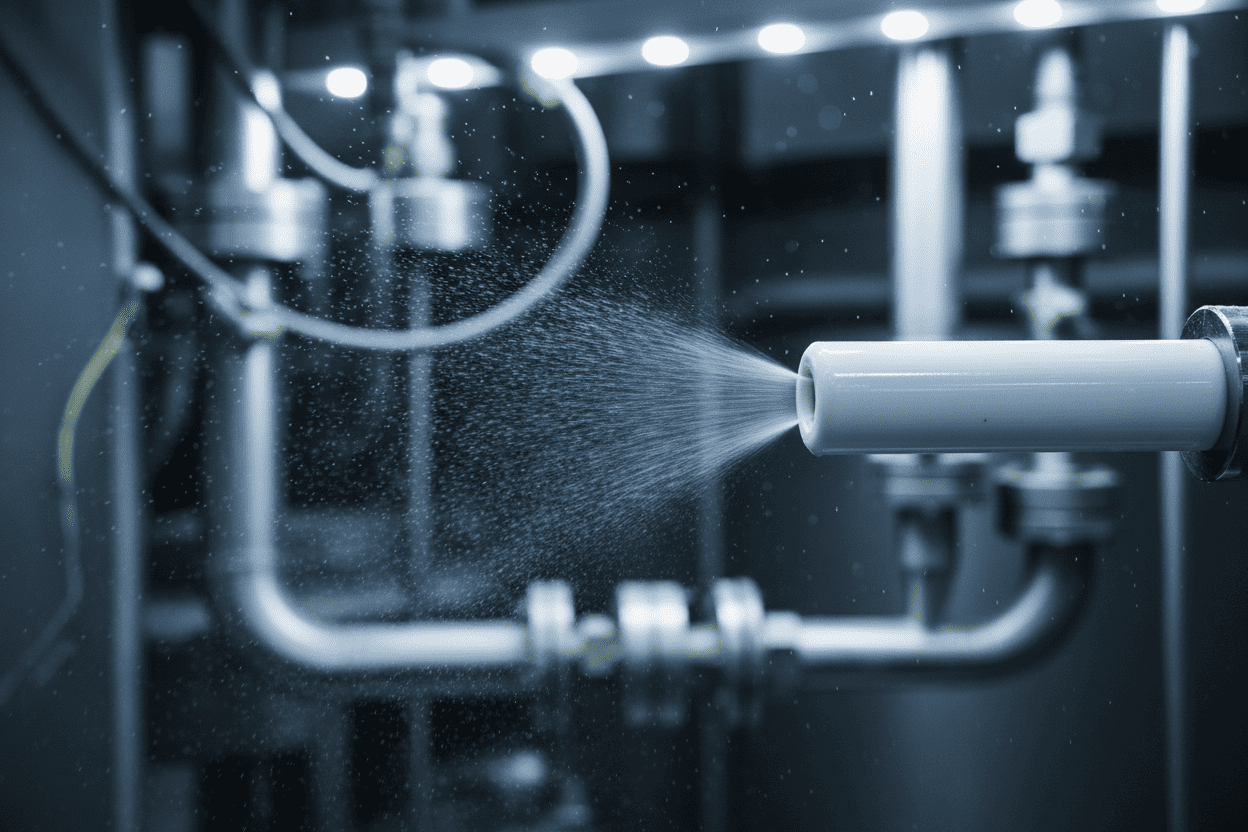
Macro shot of a high-precision ceramic orifice nozzle spraying a perfectly uniform mist in a manufacturing plant.

Table of Contents

1. Understanding Ceramic Orifice Precision: The Basics

In industries like automotive manufacturing, electronics fabrication, and food processing, precision is not just a buzzword—it is a strict financial requirement. Every drop of liquid that passes through a spray nozzle needs to land exactly where it is intended, with the correct droplet size and impact velocity.

When you use standard metal nozzles for high-pressure or abrasive applications, the friction of the fluid literally acts like liquid sandpaper. Over time, the perfectly machined hole at the tip of the nozzle begins to stretch and warp. This loss of precision leads to a chain reaction of production failures:

  • Coating Inconsistencies: The spray pattern loses its sharp edges, resulting in tiger-striping or heavy edges on automotive parts.
  • Material Waste: An enlarged orifice allows more fluid to pass through than necessary. When spraying expensive resins or paints, this translates to thousands of dollars washed down the drain.
  • Quality Rejects: In electronics manufacturing, an oversized droplet can short-circuit a PCB or cause uneven flux application.

To effectively prevent paint waste and maintain a sharp, effective impact force, the physical dimensions of the nozzle opening must remain microscopically perfectly intact. This is exactly where the ceramic orifice becomes an indispensable asset. Unlike metals that yield to friction, industrial ceramics stand their ground, locking in your spray parameters for months—even years—of continuous operation.

2. Core Concepts Simplified: Why Ceramic Outlasts Steel

To truly appreciate why a ceramic orifice justifies its upfront cost, we need to strip away the complex metallurgy and look at the physical realities of fluid dynamics. Let's break down the core concepts using plain English and relatable analogies.

The "Diamond Tip" Analogy: Sintered Alumina and Zirconia Oxide

When we say "ceramic," we are not talking about coffee mugs or fragile pottery. Industrial ceramic orifices are typically made from Sintered Alumina (Aluminum Oxide) or Zirconia Oxide. These materials are baked at extreme temperatures to create a dense, crystalline structure.

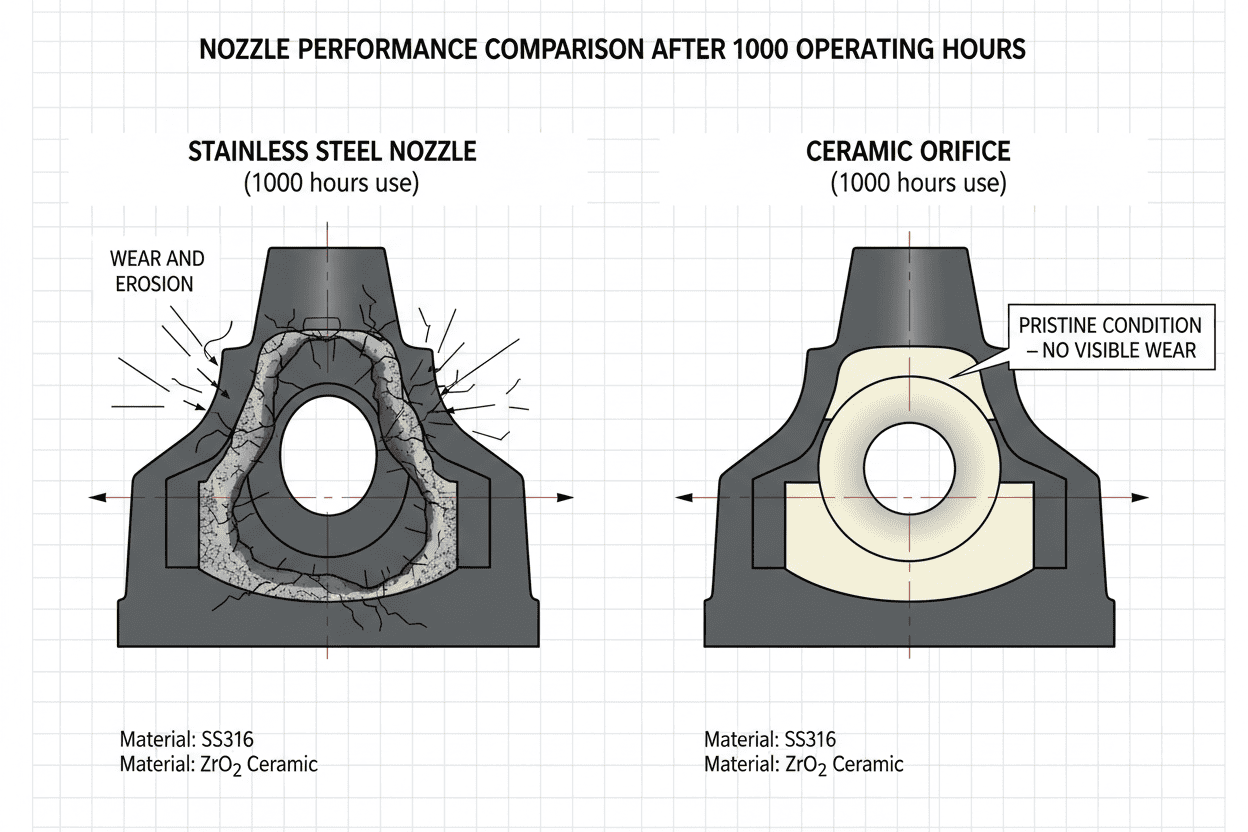
Think of it like this: If standard 316L stainless steel is a piece of hard plastic, industrial ceramic is a diamond. It boasts an incredibly high rating on the Mohs hardness scale. When abrasive particles (like metallic flakes in automotive paint or grit in cleaning slurries) slam into a steel nozzle, they gouge out microscopic chunks of metal. When those same particles hit a ceramic orifice, they simply slide off without leaving a scratch.

The "Garden Hose" Analogy: Consistent Droplet Size

Imagine watering your garden with a hose that has a perfectly round, adjustable plastic nozzle. It creates a beautiful, fine mist. Now imagine dragging that plastic nozzle across concrete. The opening gets jagged and deformed. When you turn the water back on, the mist is gone—replaced by a messy, unpredictable, and wasteful stream.

This is exactly what happens in manufacturing through Orifice Enlargement. As the hole widens due to liquid friction, precision is lost. A ceramic orifice acts like an indestructible garden hose tip, ensuring that your droplet size and flow rate control remain locked in from day one to day one thousand.

Defeating Cavitation Erosion

Cavitation Erosion is a phenomenon where rapid pressure changes cause tiny, microscopic bubbles to form and violently collapse within the fluid. When these bubbles implode near the surface of a metal nozzle, they act like micro-explosions, literally blowing microscopic craters into the metal. Because ceramics have superior compressive strength and structural density, they are highly immune to these micro-explosions, maintaining a smooth internal channel.

Cross-section diagram comparing a worn stainless steel nozzle

Comparison Table: Ceramic vs. Stainless Steel 316L

To make the best decision for your production line, you must understand the exact differences in material properties. While stainless steel 316L wear resistance is excellent for general corrosion, it falls significantly short when dealing with high-velocity abrasives compared to ceramics.

Feature / Metric Standard Stainless Steel (316L) Sintered Alumina Ceramic Orifice Why It Matters for Production
Wear Resistance Moderate (Prone to abrasive gouging) Exceptional (Near diamond-level hardness) Dictates how often you must stop the line to replace nozzles.
Orifice Enlargement Rapid under high pressure/abrasives Virtually Zero over standard lifecycles Prevents the accidental over-application of expensive fluids.
Cavitation Immunity Low (Susceptible to micro-pitting) High (Resists implosion shockwaves) Ensures the internal geometry remains perfectly smooth.
Chemical Resistance Good (Handles most standard chemicals) Superior (Inert to nearly all acids/bases) Allows use in highly aggressive chemical etching or cleaning.
Upfront Cost Low ($) Higher ($$$) Ceramic requires a higher initial budget but yields massive ROI.

3. The ROI of Upgrading: Step-by-Step TCO Analysis

Many procurement managers hesitate when they see the price tag of a high-quality ceramic orifice. It is not uncommon for a ceramic-inserted nozzle to cost 3 to 5 times more than its stainless steel counterpart. However, evaluating nozzles based solely on upfront purchase price is a critical mistake in high-intensity manufacturing.

To justify the upgrade, you must look at the Total Cost of Ownership (TCO). Here is a step-by-step breakdown of how a ceramic orifice pays for itself, often within the first 60 days of installation.

Step 1: Calculate Material Waste from Orifice Enlargement

If you are spraying a chemical coating that costs $50 per gallon, and your steel nozzle wears down, increasing flow by just 15%, you are suddenly spraying 1.15 gallons for every gallon you intended. Over an 8-hour shift, across 20 nozzles, that 15% translates to thousands of dollars in wasted coating every single week. Ceramic orifices eliminate this 15% over-spray entirely.

Step 2: Factor in Maintenance Downtime

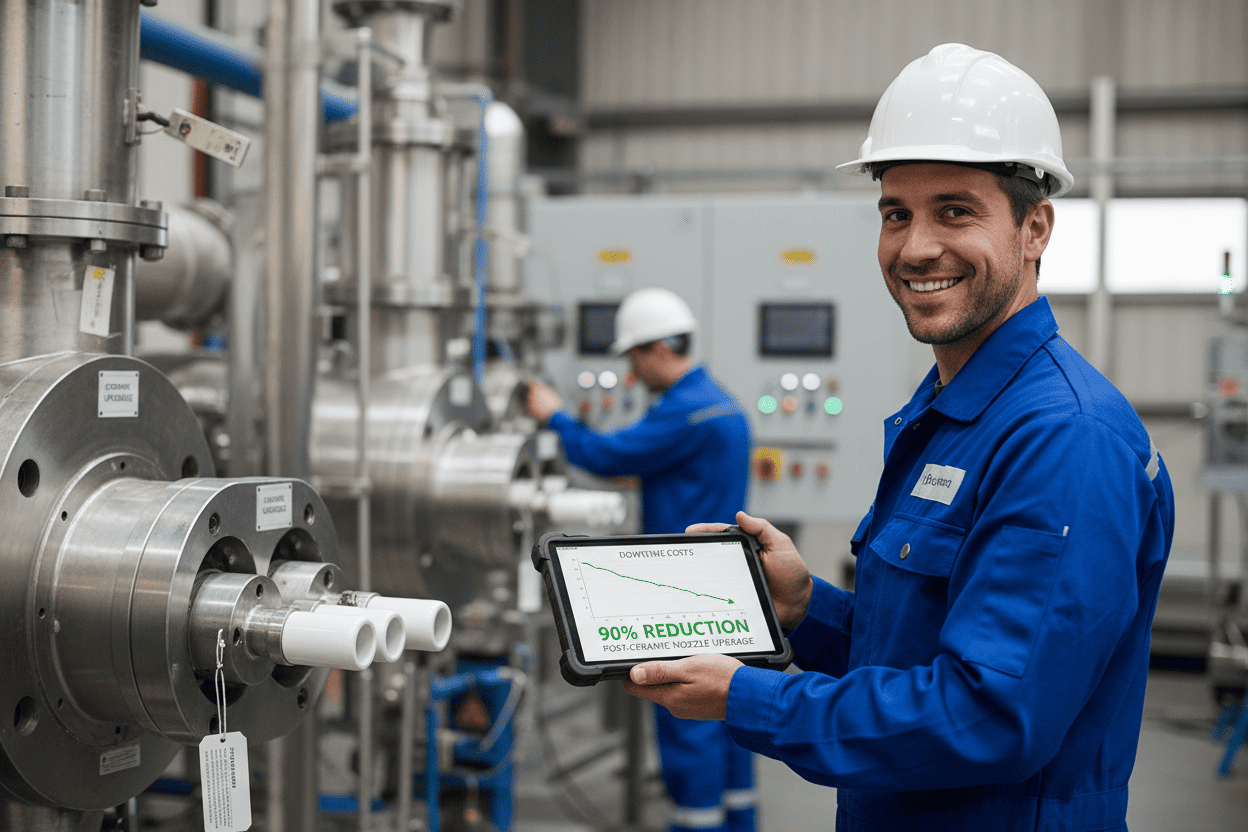
Every time a production line stops to swap out worn stainless steel nozzles, you are losing money. If an automotive paint line stops for 30 minutes, the cost of lost production can exceed $10,000. Because ceramic nozzles last up to 10 to 20 times longer than steel, you eliminate 90% of your nozzle-related maintenance shutdowns.

Step 3: Assess Quality Control and Rework

Uneven spray patterns caused by worn nozzles lead to rejected parts. Whether it is a poorly coated pill in pharmaceuticals or a streaky finish on a car door, rework costs labor and materials. By utilizing precision spray coating solutions, the ceramic orifice ensures that part #1 and part #10,000 receive the exact same coating thickness.

A maintenance engineer holding a tablet showing a sharp drop after upgrading to ceramic orifice nozzles.

Specification & Data Table: 6-Month TCO Calculation

Hypothetical scenario based on a 10-nozzle high-pressure abrasive spray system.

Cost Variable Standard Stainless Steel Setup Ceramic Orifice Setup
Initial Nozzle Cost (10 units) $150 ($15/each) $750 ($75/each)
Replacement Frequency (6 Months) 6 times (Once a month) 0 times (Lasts > 6 months)
Total Hardware Cost (6 Months) $900 $750
Labor Cost for Swaps ($50/hr) $300 (6 hours total) $0
Cost of Lost Production (Downtime) $12,000 ($2k per shutdown) $0
Cost of Wasted Fluid (15% Over-spray) $18,000 $0 (Precision maintained)
Total 6-Month Cost $31,200 $750
Net Savings by Upgrading -- $30,450 Saved

As the data clearly shows, the initial sticker shock of the ceramic nozzle is completely irrelevant when compared to the catastrophic hidden costs of using easily worn metal nozzles.

4. Expert Tips & Common Pitfalls to Avoid

While ceramic orifices are incredibly resilient to wear and chemicals, they are not invincible. Because of their crystalline structure, ceramics possess different physical properties than metals. Drawing from real-world experiences shared by maintenance engineers on industry forums, here are the crucial expert tips and pitfalls you must know before making the switch.

Pitfall 1: Ignoring the Atomization Method

Upgrading your nozzle material is only half the battle; you must also ensure your system is using the correct atomization technique for your fluid viscosity. Simply slapping a ceramic tip on the wrong setup will not fix a fundamentally flawed process. Before upgrading, you must decide between air atomizing vs hydraulic atomizing systems. Air atomizing is better for highly viscous fluids requiring a fine mist, while hydraulic is better for high-impact cleaning. Ensure your new ceramic nozzles are engineered for your specific atomization choice.

Pitfall 2: Overtightening During Installation (The "Gorilla Grip")

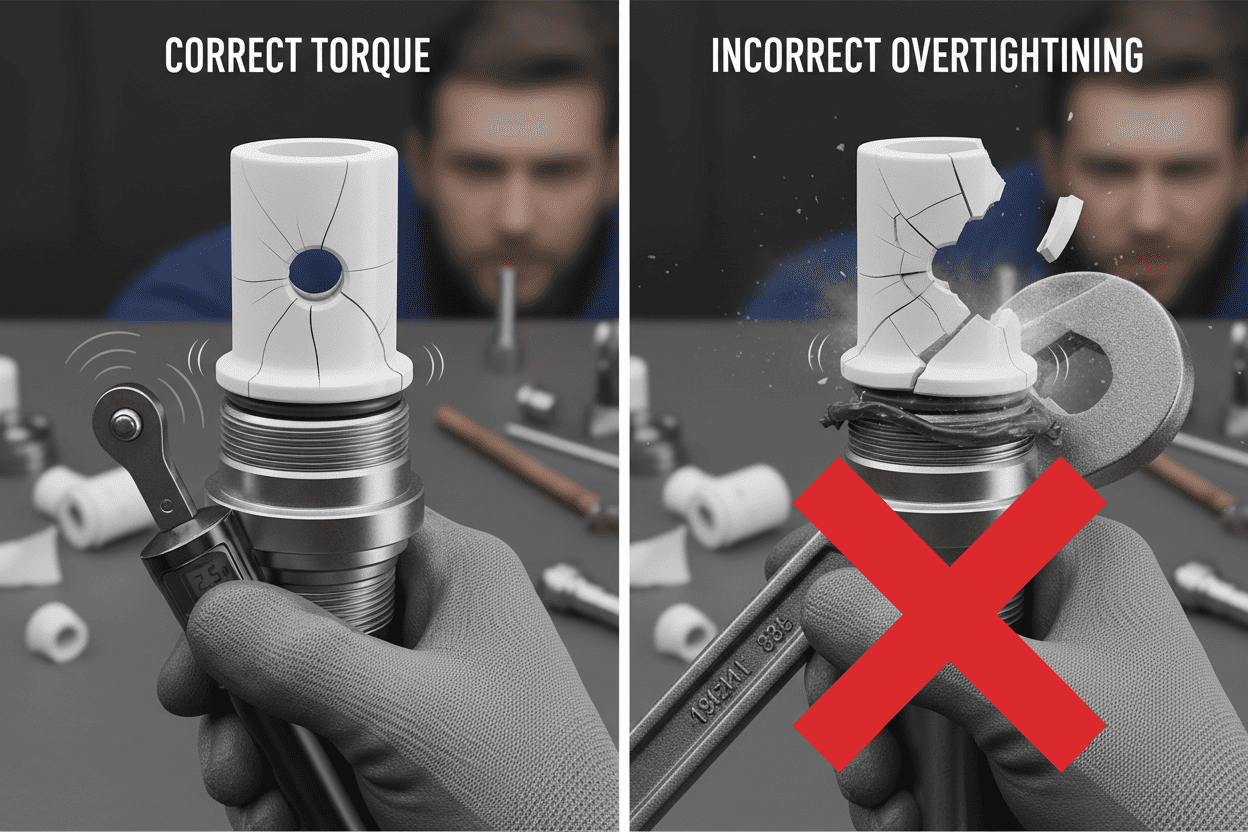
This is the number one cause of premature ceramic nozzle failure. Metals are ductile; if you overtighten a stainless steel nozzle, the threads will stretch and deform slightly, but the nozzle will survive. Ceramics are brittle. They have immense compressive strength but poor tensile strength. If a maintenance worker uses a heavy wrench and overtightens a ceramic insert, it will develop micro-cracks and shatter under pressure.

  • Expert Tip: Always use a calibrated torque wrench when installing nozzles with ceramic orifices. Follow the manufacturer's exact torque specifications. Train your team to treat them more like glass lenses than steel bolts.

Side-by-side comparison of correct torque application vs incorrect

Pitfall 3: Thermal Shock Vulnerability

While ceramics are baked at extreme temperatures and can operate in very hot environments, they hate rapid temperature changes. If your ceramic nozzle is operating at 200°C (392°F) and you suddenly flush the system with ice-cold cleaning water, the rapid contraction can cause the ceramic to crack—a phenomenon known as thermal shock.

  • Expert Tip: Always implement a gradual temperature step-down protocol when flushing or cleaning high-temperature ceramic spray systems.

Pitfall 4: Dropping Them on Concrete

It sounds obvious, but it happens constantly in fast-paced factories. A technician removes the nozzle for inspection, it slips from their gloved hands, hits the concrete floor, and chips the delicate orifice edge.

  • Expert Tip: Implement a standard operating procedure (SOP) where nozzle maintenance is always performed over a rubberized mat or a designated soft-catch tray.

5. Conclusion & Final Thoughts

In the modern manufacturing landscape, where margins are razor-thin and efficiency is paramount, tolerating orifice enlargement and spray inconsistency is no longer acceptable. Relying on standard stainless steel nozzles for abrasive, high-pressure applications is a false economy—you save pennies on the hardware but lose thousands in wasted chemicals, rejected parts, and maintenance downtime.

By upgrading to a ceramic orifice, you are investing in a "set it and forget it" solution. The near-diamond hardness of sintered alumina and zirconia ensures that your droplet size, spray pattern, and flow rate remain mathematically precise long after standard metals would have washed away.

If you are experiencing uneven coatings, rising fluid costs, or your maintenance team is spending too much time swapping nozzles, it is time to audit your spray systems and make the transition to ceramic.

6. Frequently Asked Questions (FAQ)

Q1: What is a ceramic orifice and why is it better than stainless steel? A: A ceramic orifice is a precision spray nozzle insert made from sintered alumina or zirconia oxide. Unlike stainless steel, which wears down from abrasive fluids and high-pressure flow, ceramic offers near-diamond hardness (Mohs scale 9) that resists scratching, gouging, and cavitation erosion—maintaining exact droplet size and flow rate for months or years.

Q2: How much longer do ceramic nozzles last compared to metal nozzles? A: Ceramic nozzles typically last 10 to 20 times longer than 316L stainless steel nozzles in abrasive or high-pressure applications. While steel nozzles may require monthly replacement, ceramic orifices often operate continuously for 6+ months without measurable wear.

Q3: Does the higher upfront cost of ceramic nozzles justify the investment? A: Absolutely. A 6-month TCO analysis shows ceramic nozzles saving $30,000+ per 10-nozzle system by eliminating fluid waste (15% over-spray), maintenance downtime ($2,000 per shutdown), and labor costs for replacements. The payback period is typically under 60 days.

Q4: Can ceramic nozzles handle all types of chemicals? A: Yes. Sintered alumina and zirconia are chemically inert to nearly all acids, bases, and solvents. They outperform stainless steel in aggressive chemical environments like etching baths, coating lines, and cleaning systems where metals would pit or corrode.

Q5: What are the main risks when using ceramic nozzles? A: Ceramics are brittle, not ductile. The three primary failure modes are: (1) overtightening during installation causing micro-cracks, (2) thermal shock from rapid temperature changes, and (3) physical impact from dropping on hard surfaces. Always use calibrated torque wrenches, gradual temperature step-down protocols, and soft-catch trays during maintenance.

Q6: Should I choose air atomizing or hydraulic atomizing with ceramic orifices? A: Choose air atomizing for highly viscous fluids requiring fine mist (paints, resins, coatings). Choose hydraulic atomizing for high-impact cleaning or abrasive slurries. Ensure your ceramic nozzles are specifically engineered for your chosen atomization method to maximize performance and lifespan.

Quick Summary Table: Ceramic Orifice Upgrade

Consideration Key Takeaways for Decision Makers
Primary Benefit Eliminates orifice enlargement, locking in precise flow rates and droplet sizes.
Material Science Uses Sintered Alumina or Zirconia, offering near-diamond hardness to resist abrasives.
Financial Impact High upfront cost is rapidly offset by zero fluid waste and massive reductions in downtime.
Maintenance Warning Ceramics are brittle. Avoid overtightening, thermal shock, and physical drops.
Next Step Action Audit your current nozzle replacement frequency and calculate fluid waste to justify the ROI.

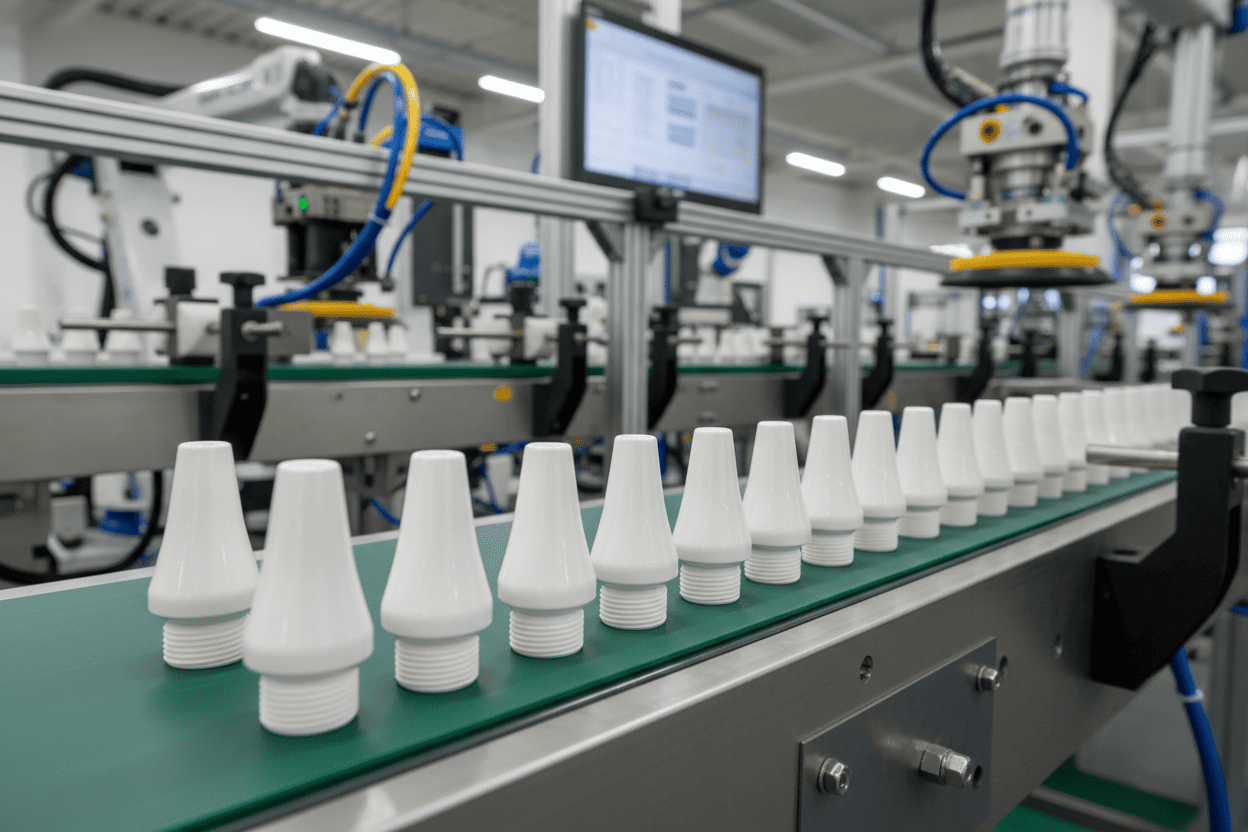
A row of brand new ceramic orifice spray nozzles ready for installation

Note to User: The following JSON-LD block is structured data meant to be injected into the <head> or body of your HTML. It is NOT visible content for the blog post readers, but is crucial for helping search engines (like Google) understand your FAQ section and potentially award you Featured Snippets.